Showing posts with label cattle. Show all posts

Friday, April 14, 2017

I Can Do It....


It's calving time. Actually, it's been calving time since the middle of February--first the pampered registered princesses, then the first calf heifers--so we've been watching this scene replayed over and over for two months--and this year it's on Cow Cam! We now have a remote-controlled infrared camera mounted in the rafters of our indoor arena/maternity ward. At 2 a.m. we could just stagger out of bed and into the porch to check the cows.

Now we've hit April, the weather has warmed up and the older, commercial herd is calving out in the pasture, where there are fewer germs to share but also so much space that doing night checks isn't feasible. I shove the husband and kid out the door at 6:30 every morning to make the twelve mile trip to the school bus, then I go drive around and check to see what happened overnight. It's sort of like hunting for Easter eggs, poking through the brush patches to see what I can find.


Unfortunately, calves aren't the only thing that's due. The fourth book in my Texas Rodeo series, Fearless in Texas, is supposed to land on my editor's desk by the end of the month and I am not exactly on schedule, so when I'm not wrangling or playing midwife I've been feverishly trying to pry words out of my brain, and reminding myself that I have, in fact, done this before. 

And trying not to be that guy who was recently arrested for taking his laptop out on the front lawn and shooting it. Five times. 

****

Monday, May 25, 2015

Adding Some Color

So today we're talking a little roping and a little cowology, and that place where the two meet. First, the roping. The last couple of years we lived in South Dakota, Greg and I did quite a bit of team roping. Then we moved to Oregon and there were plenty of tie down and breakaway roping jackpots to keep us busy, plus we didn't have space for both steers and calves on our two acre plot, so the team roping mostly went by the wayside.

Since we moved home to the ranch we've been trying to get back to it, but for one reason or another we never seemed to have the time. Now I've shed the town job and I have t

wo horses--Bailey and Vegas--who really aren't suited to anything but heading steers. And Greg finally got the heeling horse he's been looking for in Hollywood.

Now's where we get into the cowology. We keep a small herd of Longhorn cows specifically for the purpose of raising roping cattle. But since no one was team roping and the Longhorn bull was a tad difficult to have around, for several years we just bred the Longhorns to our Angus bulls. And because Angus bulls are polled--like most commercial breeds these days--and polled (aka, without horns) is a dominant trait, we had a whole string of Longhorn calves minus the horns.

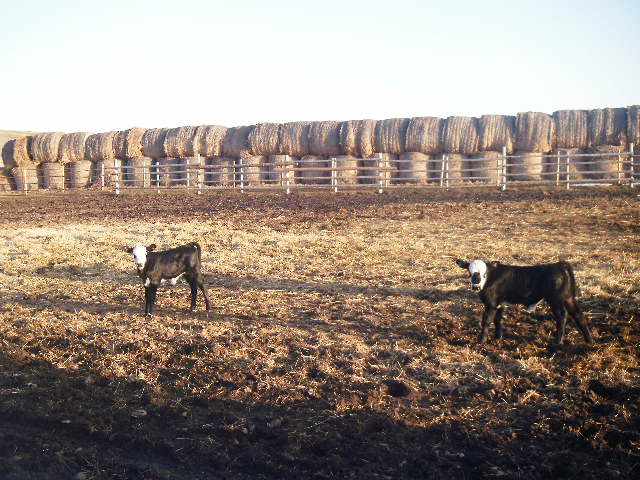
Last summer Greg decided to change that and took five of our cows down to my cousin's place to breed to his Corriente bull. The result has added a whole lot of color to our herd:


You can also see why Corriente/Longhorn cattle are favored for roping. They're lighter and more agile so less prone to injury, and stay that way until they're three or four years old. Compare the two calves about to the one below, that's out of an Angus bull. Notice how much beefier he is? Also the reason Corriente/Longhorn cattle aren't favored for beef production. Basically, they're too skinny, and it costs too much to fatten them up. Which is too bad, because they never have trouble calving and have a natural resistance to most of the common diseases that make cattle sick. 


But dang, they sure are pretty.

Saturday, May 23, 2015

Dogie Daycare

Out in the pasture today, I ran across this bunch, the only cattle in sight. Note the ratio of calves to cows:


Unless you've spent time on a ranch with large pastures, you may not realize that even cows need to get away from their kids once in a while. So they hire babysitters. No, really. Nearly any sunny afternoon you can ride through our pasture and find a bunch of calves being watched over by two or three cows while the rest of go off and graze or have a drink with the girls.

I've never checked, but I assume they take turns keeping an eye on the brats. Or possibly, like some humans, the same poor souls get stuck with playground duty every day. I do know one thing. The missing mamas are always within earshot, and will come on the run with one bark from Max the Cowdog.


Sunday, March 01, 2015

Take a Number

Each year as calves are born, they get an eartag, which is numbered to match their mother. In the event of a blizzard that separates mothers from babies, we can match them up again by number. Heifers get a tag in the left ear and bulls/steers get a tag in the right, which makes life much easier whenever we have to sort by sex.

If the calf is a heifer that we plan to keep as a herd cow, she'll get a new number when we Bangs vaccinate. (That's brucellosis, for those who aren't familiar. The vaccination is required if the cow is ever to be sold). The first digit of the heifer number is the year she was born. So a 2014 heifer has a 4 plus her mother's root number. Example: Cow 7587 (born in 2007) had a heifer calf last year.

The original calf tag in the left ear is the same as Mom's, 7587, but the daughter gets a second, permanent tag in the right ear with the number 4587. This tells us this new cow was born in 2014 and her mother was 7587, whose breeding history we know. This is important because the decision of whether to keep or sell a heifer sometimes comes down to her mother's productivity and personality. Was she a consistently early calver who never had trouble giving birth? Did she have a lot of milk? Take good care of her calf? Try to stomp us into the frozen ground when we applied the eartag in question? Is she a fence crawler who's constantly out in the neighbor's grain field and took her sweet, impressionable daughter along?


Obviously, the numbering system has limitations. There's only room on the tag for four digits if they're going to be large enough to read from a dozen yards away, out in the pasture. So if cow 7587 had a heifer calf last year and another this year, they would be 4587 and 5587, which is fine. But when 5587 has a calf in 2017 and it's a heifer, it'll be...7587. Assuming Grandma's still around, we have problem. And if 5587 and 4587 both have heifer calves in 2018, if we stuck to the system they'd both be 8587. That's when we have to assign a new number to the third generation and rely on our record-keeping to track her lineage. But since our books are in impeccable order...(cue uproarious laughter from anyone who's ever met us.)

Overall, though, the system works pretty well. Especially when it comes to good ol' 0001, who has a rather unique personality that she seems to pass on to her daughters and granddaughters almost without fail. And it's always good to know that the minute their calf hits the ground, these otherwise docile creatures are going to morph into The Pawing Cow.


~~~~~


For more information on The Long Ride Home and to subscribe to my mini-mag Rock Soup for the Cowboy Soul visit KariLynnDell.com.

Tuesday, February 24, 2015

Earn Your Spurs Podcast

Yep, it's me, yakking again. This time about the history of our ranch, what it's like when your husband is actually the boss of you, and why a writer isn't the world's most reliable employee. There's also a chance to win an ebook copy of The Long Ride Home if you check it out before March 3, 2015.


Sunday, February 22, 2015

An Earful

Three forty-five a.m. this morning, one degree above zero Fahrenheit, I was rolling around in the straw in our indoor arena, trying to wrestle earmuffs onto a hundred pound newborn while his mother wiped snot on the back of my neck.


Yeah, all his little calf friends are probably poking fun at him, but at least he won't end up like big brother, who was born this time last year when it was 22 degrees below zero. 


Sunday, February 15, 2015

A Valentine to Warm a Rancher's Heart


We didn't make any particular plans for Valentine's Day this year, mostly because I'm just back from a four day trip to Tacoma to visit my brother, followed by three nights of kid wrestling practice this week, which means we either stay at our apartment in town or don't get home until almost 9 pm. By Saturday you'd have had more luck stuffing a cat in a bucket of water than getting me in a car to drive at least an hour to go out for dinner. 

Which was just as well, because we got a little Valentine's Day surprise right here at home. We aren't due to start calving for a few more days but these things don't work on a strict schedule. Late in the afternoon my husband spotted one of our heifers in labor out in the lot. Less than an hour later, our first calf of the season was on the ground. And it's a bull! This is particularly good news for us and for him. With the combination of his early birth date and excellent bloodlines, he's already got his spot in our breeding program reserved. 

And so calving begins, and will go on. And on. And on. From now until at least early May. That's over a fourth of the calendar year on maternity watch. 

Believe it or not, we do this on purpose. The bluebloods like this heifer are bred via artificial insemination to calve early. Any later and their male offspring wouldn't mature in time to be herd sires as yearlings. Buying semen from highly acclaimed bulls means we can improve the quality of our herd genetics for less cost than buying well-bred bulls. Plus there's all that excitement every year when the new semen catalogue shows up. Better than back when I was a kid and we couldn't wait until the Sears Wishbook came in the mail at Christmas time. We have around sixty cows in the early-calving herd, a small enough number that if the weather turns brutal we can house all the expectant mothers in our indoor arena. 

Next up are the first calf commercial heifers. These are the non-pureblood two year olds, and they're bred to calve beginning in mid-March, as the registered cows are finishing up. We usually have thirty to forty of these depending on how many cows we culled the year before, and they require the closest supervision because they've never done this before. They're more likely to have difficulty giving birth and less likely to have a clue what to do with that slimy little thing they just pooped out. Unless the weather is spectacular and the calf mothers up immediately, we separate the pair from the rest of the herd for a day or so to let them get it figured out so Junior doesn't get lost in the shuffle and we can tell right away if he's not sucking. 

Then around April 1st the main commercial herd starts calving. This will go on all month with some straggling on into May. By that point the weather is usually warm enough that we leave the cows out in the pasture, these being experienced mamas, but if we do have spring storms all the cows due to calve within the next week or so are brought in and housed in the arena at night where they're under cover and easy to check.

Spreading out our calving this way means we never have more cows due to calve than we have space inside, which has saved untold numbers of newborns over the years. And in case you wondered how we know what cow is supposed to calve when--they all get an ultrasound in the fall and the vet tells us how far along each cow is in her pregnancy. We write down all the cow numbers and days bred and they get a little color-coded button tag in their ear to indicate which cycle they're due to calve. The vet is amazingly accurate, at least twice as good as back when we used to stand in the corral walking cows back and forth and arguing about whether they looked like they might be bagging up. 

As for our little bull, he's up and frisking around today, cock of the walk. We don't usually name our cows, but I wanted to call this one Valentine if it was a heifer. Since it's a bull, a friend suggested he should be Valentino. I like it. Here's hoping he grows up to be a legendary lover. 

If you enjoy what you're reading here, pop on over to my website and sign up for this thing I do that isn't really a newsletter so much as Stupid Stuff that Happened on the Ranch, but my webmistress refused to put that on the button. Subscribe here.

And of course, while you're at the website you can read all about this:


Thursday, October 16, 2014

One Way

*

There is a battle raging on our ranch right now. It’s been escalating for years, the turf war between my husband and the badgers, but the past few months it has reached epic proportions.

We've always had badgers. We've always had badger holes. A daily annoyance like foxtails in your socks and that damn west wind. But they went too far with the new corral posts. 

Dad and Greg sweated all one afternoon, digging and setting and tamping eight foot railroad ties until they stood in a perfectly straight row. But the next morning when they went out to hang the gates, one of the posts was leaning like a drunk soldier. During the night, a badger had burrowed down beside it and all but uprooted the post. Irritated, the guys straightened it out and tamped it back into place. The next morning they arrived to find not one but two posts excavated with what appeared to be heavy equipment, leaving a four foot pit around each. The badger was nowhere to be seen, but I assume he was hunkered in a burrow across the coulee, laughing as they shoveled and tamped and swore.

That’s when we got the badger traps.

Trapping badgers is tricky, and requires a lot more strategy than stuffing a trap into a hole. In the beginning, they dug around and under the traps, tossed them out like they were no more than chunks of rusty barbed wire, all the while chuckling their evil little badger chuckles.

Time for the trapper to learn a few tricks of his own.

I’m not going to go into a whole lot of detail in case you just had dinner, but suffice to say my nine year old boy can describe exactly how to extract urine from a freshly killed badger...and why. And last week my husband casually said, “Oh, by the way, my badger bait rots better out in the sun, so I wouldn’t open any of those plastic tubs in the back of the red pickup if I were you.”

It would be simpler if badgers were the only occupants of our pastures. Our trapper takes great care to shove his traps far down the holes, but one can never underestimate how far a cow will go to get into what she shouldn’t.

Which is how we ended up with a cow with a badger trap stuck on her nose. 

To fully appreciate her predicament, I need to explain that the trap was attached to a length of wire wrapped around a four foot chunk of fence post, designed to keep a badger from dragging the trap deep underground. Along comes the cow, innocently shoving her face down a hole for reasons comprehensible only in her little cow brain and WHAM. She fell back, trying to shake off whatever had clamped onto her face, and got the post stuck behind her back feet.

So now she’s got a trap on her face and her head snubbed down between her knees, held tight by wire and the fence post wedged behind her hocks. In other words, this was not a happy cow.

There was nothing to do but rope her. Considering she couldn’t run, it should’ve been simple. Except Greg and my brother in law Richard were both mounted horses that hadn’t done much pasture roping and neither horse had ever seen a cow packing quite that much hardware. After no more than half an hour of kicking and sweating and swearing, Richard got Bailey close enough to toss a loop around the cow’s neck. 

But now she was really irritated. Every time Greg got close to the heels the cow would kick and the chunk of post would fly up, and his horse would jump halfway to the next county. Plus how in the heck do you heel a cow with a post in the way?

Finally, she gave a mighty kick, snapped the wire and sent the post flying. Greg rode in and snagged both heels. Richard tightened up his end of the rope and hopped off to remove the trap. Bailey, being new at this and not particularly loyal to begin with, took Richard’s dismount as a sign it was time to go home, but when he turned to leave the rope touched his butt and he blew up and went to bucking around in a circle at the end of the rope. Richard had to dive for cover or be clothes-lined. Greg’s horse whirled and tried to bolt, but Greg held tight to his dallies, managing to stay a jump ahead of the bouncing, snapping rope attached to Bailey's saddle. And somehow, in the midst of the wreck, the neck rope snagged on the trap and popped it off the cow’s face.

The cow stopped bellering. Bailey stopped bucking. Richard climbed to his feet, dusted himself off and got his rope off the cow’s neck. Greg released the heel loop. They all watched her wander off, shaking her head as the horses and men gathered up their gear and frayed end of their nerves.

“Well,” Richard said. “I guess that’s one way of doing it.”

*

Sunday, March 02, 2014

Don't Step in the Afterbirth....

...and other ranch wisdom:


That's our indoor arena, in case you wondered. You can see the roping boxes when I get down to the far end. And yes, if the temperature is more than about fifteen degrees, give or take the wind chill, it does get too warm in there too keep the door shut. More precisely, it gets steamy and damp, which is the ideal breeding ground for bacteria, which leads to things like pneumonia.

And if you just can't get enough, here's my first attempt at videoing the two A.M. cow check. The one where there were actually new babies, but the iPad ran out of memory halfway through:


*

Thursday, May 06, 2010

And So On, And So On....


Still snowing, and even colder this morning. This bunch of cows got pushed south by yesterday's wind and snow. Dad and Greg spent the whole afternoon getting them back to the south shelter. This morning, I saddled up Nico and pushed them on to the house, while Greg led the way and broke a trail with the tractor, packing a big round bale of hay for incentive.

Then it was on to doctoring calves that are starting to get sick from all the cold and stress. Mostly in the form of what we call 'scours', which is the bovine version of diarrhea. Since it's bacterial, we can treat it with antibiotics. But if they get too dehydrated, we also have to 'tube' them with an electrolyte solution, the calf version of a Pedialyte popsicle. Or cherry Gatorade. Since calves won't voluntarily swallow the stuff, we have to get it into them via a long plastic tube with a large catheter-type thing on the end that is slid down their throat and directly into their stomach.


This one will stay in the barn warm and dry for the rest of the day, get another electrolyte treatment tonight, then we'll decide whether to take him back out to his mother, or bring her in to him. In the meantime, I'm wondering if we can sue Al Gore for deceptive practices or something, because if this is global warming, I don't want to see what happens when we cool off.

Sunday, May 02, 2010

Mass Chaos

Imagine you're in a huge city park. In this park there are hundreds of families picnicking, when suddenly a storm rolls in, with fierce winds and hail. Everyone runs for cover. In the confusion and panic, children are separated from their parents. Some latch onto the first adult they see and follow them in hopes of being led to safety. Some just run in whatever direction will keep the wind at their backs and the hail from stinging their faces. Fences are trampled in the rush to escape the brutal weather. Children and adults are driven beyond the boundaries of the park and into the surrounding area.

When the storm passes, children are scattered for blocks in every direction. Some sit or lie down and wait to be found. Others begin wandering in search of their parents, but with no idea which direction they came from or which direction their parents went, they end up even more lost. Parents are running around yelling for their children. Kids are so exhausted they don't answer.

That pretty much sums up what happens when a blizzard hits a herd of cows. Ninety percent of the time our shelters are sufficient to keep the cattle from wandering. The blizzard we had two days ago was in that top ten percent. Records were set for wind speeds and snowfall amounts. The drifts piled up so fast and so high they filled the calf shelters and pushed the herd out into the storm. The wind pushed them through creeks and fences, over hills and into coulees. Cows and calves from the west field ended up clear out south, along with cows and calves from our registered herd in the east field. Cattle from the west field were pushed up and over the ridge and down the road into our neighbors' pastures.

Once the storm ended, calves either hunkered down where they'd ended up, or began wandering in whichever direction they thought seemed likely to take them home. For two days, my view of the world has looked pretty much like this:


We've been attempting to locate all of the missing cows and calves, return them to a central location, and reunite them with their mothers. Today we found a calf trotting down the main gravel road, three miles from home, headed in the wrong direction. Sadly, I do not have video of my husband roping him out of the back of the pickup. You're also not going to get to see me trying to chase down and rope a calf on foot while leading a horse, with a quart bottle of milk tucked under one arm.
By late Saturday evening we had most of the cattle back where they belonged, or at least mothered up. There are still half a dozen of the neighbors cows in our south field but their calves are with them, so they'll stay until more urgent matters are attended to. Sunday morning we'll be back at it, looking for motherless calves, childless cows, and the inevitable sick calves that always follow a major storm.

What we haven't found so far are any dead calves, which is an outright miracle given the severity and duration of the storm. So even though we're exhausted and saddle sore, the day still came to a beautiful end.

Saturday, May 01, 2010

Diggin' It

So it snowed again. As usual, we got a little more of the white stuff than pretty much anybody, with the possible exception of the top of the mountains. 


That's one of my house cows as seen out my front door on Friday morning. She and two others plus their calves showed up as the storm started Wednesday night and spent the duration hunkered in the trees in my front yard. Those three were the only ones we were able to feed on Thursday. We couldn't even get hay up to the expectant mothers in the indoor arena, because of near zero visibility and drifts like these:


Friday morning it was time to dig out. First, we had to get the cows out of the arena, which meant getting the fifteen foot tall front doors open. Greg dug out the biggest part of the drift with the tractor, then I had to clear out the rest with a shovel. To add to the fun, the storm started with rain, making huge sheets and chunks of ice on the wall, the doors, and the track the door runs on. As I tried to push it open, the ice broke loose and pelted me on the head and arms. Meanwhile, forty cows were piled up just inside the door, waiting for me to get it open far enough to trample me on the way out. 


Then it was on to the bulls. All of the yearlings were trapped in the upper lot by a huge snowdrift. The only way to get them out was to shovel a trail, which ended up looking more like a tunnel. For reference, that fence you can see behind the drift is five feet tall. 


Whew. Done. Well, except for the horses. They were in that barn in the top picture. The geldings were no problem, just open the back door and let them break their own trail out through the back corral. But the mares had to come out the front door. The one beside that pickup that's just barely visible under that big honkin' drift. Yeah, that one:


Once all the horses had been freed, all I had to do was shovel out the back of the pickup to find the hay bales, load them one at a time on the four wheeler, and drag them out to wherever I could find a spot that was less than belly deep. 


Then it was back to the house and the most important job of the day. The power had finally come back on. Time to clear the snow away from the satellite dish so the kid could watch his cartoons. 
So much for the morning. Now all we had to do was find the rest of the cows and calves. 


Tuesday, April 20, 2010

Doubling Up

Last night we had the smallest calf I have ever seen alive. He weighed less than twenty pounds, barely reached my knee. We were amazed that he managed to stand up and suck down a pint of milk. And sad, if not surprised, when he didn't make it through the first day. To cheer myself up, I took pictures of our twins. Well, tried to take pictures. Between them tearing around and their mother snorting and pawing dirt, I had a little trouble getting both of them in one frame.


As you can see, they're not identical. The one with the black spots on his face is a bull. That's called brockle-faced, and indicates a mixture of Angus blood and a white-faced breed like Herefords, which is called bald-faced, or baldy, which is not considered an insult to a cow, but I wouldn't recommend tossing it around in a biker bar.

The other is a heifer. She isn't quite a baldy because she has one black eye. When there is one twin of each sex, the heifer will usually be sterile. As a person who took over forty credits of college biology I should be able to give you a very detailed explanation of this phenomenon, but I'm drawing a blank and too lazy to go look it up. Plus, I'm sure one of my incredibly intelligent readers will explain it for you down in the comments.


There. I don't know about you, but I feel better about life in general.

Sunday, November 08, 2009

Rancher's Gold


      An early morning rainbow in the east may mean good luck. The same rainbow in the west means you’re about to get wet. The front swept down the slopes of the Rockies and met me a mile from the house. I tugged the brim of my cap lower over my face. Nico bowed his neck, slitting his eyes against raindrops that felt like miniature ice picks as we loped square into the wind.
     So much for the fifty-five degrees and sunny the weatherman had promised for shipping day.
     Didn’t help that we were on what I knew was probably a fool’s errand. Chances that any cattle would be in the west pasture were slim. But I didn’t dare assume. First time I didn’t bother to check would be the time a couple of cows were lounging down in the coulee with their big steer calves at their sides.
     So Nico and I fought the wind and the rain across the flat, down through the coulee, up the other side to the top of the rise, so I could see clear to the north fence.
     Nothing.

     We wasted no time swapping directions and putting the wind at our backs. As we trotted along the fence, skirted a bog, and jogged through the gate into the east pasture, the rain buckled down and got serious. I yanked up the hood on my Carhartt jacket and cinched it under my chin. There was nothing I could do about the icy water pooling on the back of my saddle and trickling down into the seat to soak my butt. My thighs were already wet clear through my jeans and long underwear.
     I hadn’t even chased a cow yet.
     The John Deere tractor rumbled over the hill from the house, lugging a round bale. My husband, no doubt chuckling and patting himself of the back for agreeing the night before to let me ride instead of driving the tractor. He would lead the way, hoping the cows would follow breakfast right to the corral.
     Nico and I started east, toward where I’d seen a cluster of cows clear up on the ridge. Mom was there ahead of me. When I spotted the four wheeler bouncing up the incline through the buck brush, I swung south instead. I should go clear to the road, but the cousins who lived west of us would have driven past on the way to help us, and I figured they’d have unloaded a rider or two to bring anything they saw clear out there. So once I’d reached the point where I could see there was nothing at the far reservoir, I turned north.
     Four more riders had arrived while I was making my loop, the cousins from the east. They’d already pushed the cows down out of the draw and onto the meadow. The rain did bring one perk. The band of horses that generally did their best to cause as much trouble as possible was huddled behind the calf shelter, tails to the wind. They weren’t budging.  
      I circled up the hillside and helped Mom push her little herd down to the gate and across the meadow. We caught up with the main bunch as they hit the barley fields. Water beaded on Nico’s ears and trickled down to plaster his mane against his neck. He pushed at the bit, annoyed at having to slow his pace to match the cows. I had to guess the identities of the other riders from their general sizes and shapes, bundled up and hunkered down against the rain. Like me, they’d all dressed for cold, but no one had expected the rain.
      The cows moved along pretty good until we hit the corner and tried to turn west. They took three steps into the teeth of the wind and mutinied. By then, my gloves were soaked clear through. My hands turned to cramped popsicles as we all trotted back and forth, shouting and coaxing and cursing at the reluctant herd.
      And the rain stopped.
     A patch of sky cleared, golden sunlight streamed through. The cows turned, suddenly cooperative. As we topped the last hill, the rainbow reappeared, curving ahead of us, right to the corral where we would sort of the calves to sell.
     Despite the wind cutting through my wet clothes, I had to smile. It seemed fitting. Shipping day is as close to a pot of gold as a rancher ever gets.


Hauling a load to the scales.


A snow squall hit as I pulled out with my second load.


Trucks waiting at my aunt's scales, lined up and ready to head for Nebraska.

Friday, June 12, 2009

Sure He Can Run...But Can He Walk?

We raise rodeo horses. Therefore, we breed for speed. Speed is important in the arena. On the ranch, however, speed is optional, and generally hazardous to your health. There are rocks. There are holes. Coulees, washouts and bogs. Slick green grass. Bottomless mud pots called soap holes. All of which are best encountered at a moderate pace. When it's time to work cattle, nobody cares too much whether a horse can run. But we’ll elbow each other out of the way and even throw a good trip on the way to the barn to get our hands on the one that can walk. Why fight for a horse than can walk fast? Because cows are best moved along in a leisurely manner. Especially cows with a calf by their side, if you’d like mother and child to end up somewhere in the same county. The cowboy rides along behind, shouting encouragement as needed, zig-zagging this way and that to keep the herd moving. Over to the right there’s a calf who just realized that he’s starving and he must eat right now. Hard for a cow to walk when there’s a kid latched on to that particular body part. Off the left is that old red cow that tries to peel off and head west every fifty yards. In the middle, three calves have lost track of their mothers and are convinced that they must go back to where they last saw her. Mostly it all happens in slow motion. Walk over here. Walk over there. Walk over here again. It can go on for miles. This is when you truly appreciate a horse with a smooth, ground-eating stride. It’s also when a horse that can’t or won’t walk becomes a four-legged torture device. Climb aboard a lazy horse, and at the end of the day you'll feel like you pedaled a tricycle over the Rocky Mountains. Worse, though, is one that does everything but walk. They jog. They paw the ground if you try to stand still. They run sideways, jerk at the bridle, perform gymnastics akin to the leaps of the famous Lipizzaner stallions, all the while grinding your butt and knees into a saddle that has no appreciable padding. A good fast walk isn’t automatic. It has to be learned. And it seems to come unlearned when a colt makes the move from pasture work to the arena. Suddenly, they discover speed, and it’s addictive. Who wants to plod when you can fly? The more aggressive the rope horse or barrel horse, the less likely that they’ll be a pleasure to ride anywhere else. Betsy was one of the worst. At barely fourteen hands, she was only a size larger than the average Shetland pony. A classic, well built roan, she was a pretty little thing…from a distance. She wasn’t quite so cute after she ran full length of you when you tried to corner her in the corral. And stepped on your foot at least once—with deliberate malice—while you were saddling her. Once aboard, she had a mouth like granite, a head to match, and roan Hancock attitude coming out her ears. But man, was she fun to rope on. Anywhere but the arena, Betsy was punishment from hell. Getting her to walk away from the barn was like pushing a canoe upstream with one hand. She veered left, then right, then left, and if you let your guard down for even an instant, she’d swap ends and head for home. Finally, after hours of kicking and wrestling her every step of the way, you’d dump the cows into the target pasture and turn toward the barn. What a relief. Not. The instant you turned around, Betsy would grab the bit in her teeth and blast off. Given her size, it should have been easy to stop her. Wrong. You’d brace both feet in the stirrups and haul back on the reins with both hands and all your might. She’d bow her neck, set her jaw and keep going. Assuming you’d eaten your spinach and picked a good stiff bit, you could keep her to a bone-rattling, side-stepping, nose-rooting trot. Forget stopping. If you tried, she’d flip around and run backwards. It would have been easier to get off and walk home if it hadn’t been for that trick where she ran a circle around you, over at least one set of toes, then tried to bolt while she had you tangled in the reins. Ember is Betsy’s child. She’s only half as obnoxious as her mother, and not near as tough. And she can’t walk a lick. It’s not her fault—she never grew out of the chubby little girl phase. She has the stride length of a gopher. Her short legs churn as fast as they can, and still the others leave her in the dust. Every fifty yards she has to break into a jog to catch up. I know just how she feels. At cattle moving time, you want to grab Vegas or Scotchman or Pocket or Julie. Nico if he hasn’t been roped on a lot lately and isn’t too fresh. Bailey as long you remember not to wave your left hand, or are prepared for the consequences. He can jump sideways a fair distance for a big horse. At some point, we will end up riding side-by-side. It looks casual. Reins slack, conversation idle, horses strolling along. Except I’m pretty sure Pocket can out walk Vegas, with a little extra squeeze of my heels. Greg is pretty sure she can't. And no way is Dad going to let us make his horse look bad. The race is on. First to the barn without breaking into a trot wins. ‘Cuz out here, horses that can run are thick on the ground. But one that can really walk—that’s something to brag about.

Saturday, May 16, 2009

Now that's more like it

Finally, things are starting to look more like this instead of a scene out of A Christmas Story.

Sunday, May 03, 2009

The Pocket-sized Cow Horse

I may have mentioned that we’ve had a little snow lately. Just an average April snow shower, with enough accumulation to bury a short elephant, if one were ever foolish enough to wander into northern Montana in the spring. The snow is melting now, leaving behind fields covered in water and slush and mud. The footing is treacherous. Badger holes lurk under harmless-looking patches of leftover snow. But there is still work to be done, and not all of it in a pickup. My husband broached the subject at lunch on Sunday. “I need you to go up on the hill and bring in the heifer that lost her calf.” The sun was shining, the temperature above forty degrees for the first time in a week. I agreed. There are three horses in my personal herd at the moment. Ember is the prima donna, the first string rope horse, and good enough at it that her cute little nose would be seriously out of joint if someone expected her to go out and play ranch horse. Plus, she’s obnoxious to ride in the pasture. Roo was raised in a part of eastern Oregon that gets slightly less rain per year than Tucson, Arizona. He balks at oversized puddles. Forget splattering across a submerged field, through chest deep snow banks, and across a draw swollen with runoff. That left Pocket. Pocket is my cow horse. Her name is a direct reference to her size. Small enough to get on in full winter attire, agile enough to outmaneuver any cow. Her greatest claim to fame is a grandfather who won a few horse races. Thoroughbred aficionados might recognize the name. They called him Secretariat. Having spent a lifetime on this ranch, Pocket can navigate a minefield of badger holes with nary a stumble. She doesn’t trip over rocks or her own feet, and rarely slips, even on the most greasy ground. And she will go anywhere. Swamp, near vertical coulee descent, snow bank, creek. Point the way and she will go. Mostly, this is a good thing. But it does lay the burden of decision-making on the rider. A more cautious steed will pause, look back, give you that ‘Are you sure?’ look before venturing into a horse-swallowing bog. I’m not sure Pocket would hesitate if I asked her to stroll off the edge of the Grand Canyon. Sunday, though, was a good day to have the fearless Pocket as my partner. The cow was not interested in being herded from a sunny, rapidly greening pasture into the barn. We urged her forward. She went left, through a foot deep pool of slush, into a bog. Pocket followed. The cow went back to the right, across the muddy road and into a snow bank clear up to her belly. Pocket followed. Just shy of the gate, the cow made a break down the fence, across a stretch of slippery, wet grass, through more snow, and down into the water-logged draw. Pocket followed. At that point, the cow threw up her hooves and surrendered. We pushed her through the gate--guarded by a snowdrift ten yards across and a good three feet deep--and into the waiting pen. Mission accomplished. We headed for the barn and a well-earned bucket of oats. And of course, Pocket followed. Pocket, still in her winter clothes.

Tuesday, April 14, 2009

Storm Warning

The tension begins to mount as soon as the forecasts are released. Winter weather advisory. Storm warning. Blizzard. Bad enough in January and February, when temperatures drop into double digits below zero, and the wind chills are murderous. But spring storms--March, April, May--have a special brand of cruelty. Calves are days, hours or minutes old. Cows have been lured from the shelter of corrals and haystacks by the first flush of green grass.

All have been lulled by a few bright, warm days.

You prepare as best you can. Shelters are strategically placed, bedded with straw. Hay is rolled out to tempt the cows to bring their babies to safe haven. You have to honk your horn to push through the herd, scatter the calves that buck and play. A bull calf stands his ground, shaking his head, ready to show you who's boss. Will that sturdy little body be strong enough to weather what is to come?

 The youngest and the weakest and the most likely to give birth are gathered into the barn. You want to take them all, but there isn't room. Overcrowding is as dangerous as the storm. Babies could be trampled. Too many warm bodies in the enclosed space turns the air into an incubator for pneumonia. Killing them with kindness.

 So you do what you can to protect them in the pasture. But what if the wind changes? Your shelters are designed to protect against prevailing northwesterly winds. An east wind could drive them away to bunch against fences, the little ones mashed in the herd, separated from their mothers. If the fence gives way, they will drift with the wind, scattering over miles of countryside.

You wonder what it must have been like all those years ago, when your grandparents were a young married couple. Life without twenty-four hour radar maps on TV and Internet. When you got only an hour, maybe two at best, as the wall of grim, gray clouds rolled over the Hudson Bay divide from the north and bore down on your unsuspecting herd. When you risked your life to lay out feed with a team of horses and a hay sled before the storm hit and you could no longer find your way home.

 Even now, the weather reports are unreliable. The two nearest reporting stations are fifty miles away, one north and one south. Both are over a thousand feet lower in altitude, and a world away in microclimate. The last storm barely dusted them with snow, but dumped over a foot in your yard. You listen to reports from both towns, extrapolate the difference, then calculate the effect of increased altitude and proximity to the mountains.

 In other words, you guess.

 The wind sharpens to a bitter edge, cutting through your thickest coat. The first flurries sting your face as you break and scatter the last straw bale. The horses are last. They stand hunched against wind, watching the barn door. When it opens, they come at a trot, snorting and blowing puffs of steam into the frigid dusk. 

Finally, you retreat to the house, physically exhausted by the scramble to prepare, keeping a leery eye to the north and west as darkness falls. You lie in bed, listening as the front rolls in. A slow roar builds in the trees behind the house. Snow pelts the windows. The landscape dissolves into a swirl of white. Then there is nothing left to do but wait. To watch the mercury plummet, and remind yourself of the times that the wind blew harder, the temperature dropped lower, the snow piled deeper.

Incredibly, miraculously, for the most part the cattle survived. Their capacity to endure is staggering. Through the endless, brittle night you remind yourself of those past miracles. Try to forget the times when nature won the battle. And you pray.

*